







~ Seed for CABBAGES ~
There are 3 types of cabbage, named for when they are ready to eat. "Spring" and "Summer" cabbages are smaller & more tender, but the "Winter" ones have longer to grow and so are much bigger.
Rather than offer a huge list of similar types for
you to try to choose between, we have instead selected just a few good varieties from each group.
Cabbage - ready to eat year round

Paul & Becky's Asturian Tree Cabbage
Although this is truly a cabbage, it grows very much like a kale. It produces a 2 foot stalk with a loose head on top. You simply take the huge leaves a few at a time to eat all year round.
You can even keep it going for two years or more. Just cut it back when it tries to flower - it makes new growth, ideal for fresh cabbage in spring during the ‘hungry gap’.
Cooks like a cabbage, rather than a kale, and also a key ingredient in the classic Spanish dish 'Caldo Gallego' - which is a delicious leaf, bean, and meat stew.
Tastes like cabbage, harvested like a kale . Short lived perennial provided the flowers are removed as they form.
 150 seed, organic. £
Sowing Information

SPRING Cabbages - ready to eat in Spring
Sowing Information
'Spring Cababges' and 'Spring Greens' are sown in late summer, then plant out the baby plants in September & October; they'll grow overwinter for harvest the next Spring. Space about 12-18” apart in rows 24-36” apart. Firm, well manured soil is essential.

Baccalan de Rennes Spring Cabbage
This great traditional spring cabbage from Rennes in France returns to the catalogue after a 10-year absence! Loose rosettes in spring then form firm heads that are halfway between round and pointy – like a rugby ball.
A large oxheart-style early spring cabbage, very popular both in France and Portugal.
 approx 300 seeds £
Sowing Information
Normally sow in late summer/early autumn for harvest the following spring. Ideal for harvesting small loose heads as “spring greens” or leaving to heart up fully, as in the photo.

Durham Early
A very reliable old variety of spring cabbage with dark green solid conical hearts, usually ready towards the end of April.
300 seed £
Collards - Also Ready to eat in spring
‘Collards’ are another type of Spring Cabbage that never really makes a head, and they're normally sown in late summer for loose heads the following Spring.
Sowing Information
Sow in July/August & plant out in September; they'll grow overwinter for harvest in Spring (Dark Green). Note: they are fairly heat-resistant, so you can also sow them in Spring, for a crop in July (Light Green) , but it's more useful to grow them overwinter.

Georgia Wakefield Collards GUEST VARIETY FOR TRIAL
An ancient variety of cabbage, pre-1850, that doesn’t really heart up but instead makes large loose rosettes of delicious tender leaves with white ribs. Rarely available!
Normally grown as spring greens, but unlike most cabbages, collarads are unusually resistant to hot conditions, so you could try it as a summer cabbage too.
approx 250 seed £

Ultracross Heirloom Collards
A unique population of traditional collards collected in the 1970's from backyard vegetable plots. These languished in in a government seedbank until brought back to life by the Heirloom Collard Project in 2020.
The original varieties were collected by Edward H. Davis and John T. Morgan from seed savers across North and South Carolina many years ago. The Heirloom Collard Project grew them all out and let the best ones cross to create this very mixed population.
The idea is that you can select the ones that do well in your conditions and keep seed from them, to maintain your own special strain perfectly adapated to your conditions.
 about 150 seeds £

"Purple Ultracross" Breeders Selection Collards
A breeding mix of purple collards! When the Heirloom Collard Project grew out their collection, now & then they would get plants with some purple leaves.
These might be valuable as purple leaves can be associated with frost-resistance, so they saved seed from these seperately, and then croseed them to start a purple-leaved population - and we've managed to get hold of a little bit of it for you to try out.
A very small starter packet of seed from their breeding program!
80 seed breeding population £
SUMMER Cabbages - ready to eat in SUMMER
Sowing Information

‘Copenhagen’ Market Summer Cabbage
A very reliable & productive variety introduced by “H. Hartmann and Co.” right back in 1909. It quickly makes solid round heads 6 - 8” across, and the medium-sized plants are good for small gardens.
This did really well for us even in then terrible summer of 2024!
approx 300 seed £

Nantais Hatif Summer or Autumn Cabbage
French variety with round heads on a short stem. Quick to head up, flexible in use: Sow March and April for harvest Aug -Sept, and sow again July & August for harvest April & May.
300 seeds £

Golden Acre Summer Cabbage
This is a really good summer cabbage that makes tight round heads that are a very attractive golden-green colour, and an excellent flavour. (The colour hasn't shown so well in the photo, but a row of them in the garden really does stand out glowingly.)
Sow relatively early in spring, and you can harvest at that useful period before the main summer crops get going.
approx 250 seed £

"Belarusskaya 455" Summer/Autumn Cabbage
This European cabbage is a great long-storing, hardy heirloom from Belarus, near the border with Poland. It is one of best two we found in our 2017 trials of old ex-USSR varieties.
Productive! Makes flattened heads in about 100-130 days that are nice and tight, very pale green (almost white) , weighing 2 to 3kg.
Bred sometime before 1945 by the seed company Vniissok, from an even older Belarussian heirloom.Consider keeping your own seed, we don't produce much of it.
180 seed, organic. £

'Great Oxheart' Summer/Autumn Cabbage
A traditional cabbage making medium sized pointy heads (about 3lb / 1.5kg) Normally sown in spring for a summer-autumn crop, it’s quite quick growing, ready in about 100 days.
Pointy, a decent size , and moderately quick.
300 seed £

Greyhound Summer/Autumn Cabbage
A traditional compact cabbage ideal for smaller plots, with not too many outer leaves and a nice dense conical head. Normally sown in spring for an early summer crop, this received the RHS Award of Garden Merit in 2002.
A much-loved variety that is suited to sowing and harvesting over a long period.
250 seed £
Sowing Information
We've given this one its own calendar , as it is a bit more flexible than the others and you can grow it at a wider range of times.

Hope (“Nadezda”) Summer/Autumn Cabbage AVAILABLE AGAIN!
From soviet-era Bulgaria this is a lovely flattened heirloom cabbage with a particularly mild sweet flavour.
It was originally bred by crossing two great varieties from either side of the Iron Curtain: 'Glory of Enkhuizen' with 'Plotnokochannaya' , at the West-Siberian experimental vegetable station in the early 1970's.
Dense, sweet, flat pale green heads around 1 - 1.5kg in weight, ready early winter.
About 200 seeds, organic. £


AUTUMN Cabbages - ready to eat in AUTUMN
Sowing Information

'Rouge Tete Noir' Late Summer/Early Autumn cabbage
A real unsung hero. We've offered it for years and never really praised it sufficiently, but looking at them on the field one autumn we realised again just what an excellent cabbage it is. With no care or attention it grew through the wet and drought and made great firm heads that the caterpillars and slugs left alone. It's fab!
A super-reliable red round-headed variety for late summer & early autumn harvest, great shredded in salads or coleslaw as the deep red surface contrasts with the white flesh inside.
We have found that red cabbages seem to be somewhat less affected by caterpillars, perhaps because they show up more to the birds on the red background?
Firm red heads, short stem. Sow in spring for use mid-summer onwards.
300 seed £

'Kalibos' Late Summer / Autumn Cabbage -POINTY
It's very unusual to find a red cabbage this shape! This is a wonderful heirloom variety with pointy red heads, it's a quick-growing sweet cabbage for late summer or early autumn harvest.
Sow in spring for use mid-summer onwards.
about 200 seed £

Winter Cabbages - ready to eat in WINTER
Cold tolerant cabbage also makes a good over winter or very early spring crop in a polytunnel.
Sowing Information
They can be sown from March to mid-summer, to give them a long time to make a large head that should then resist the cold, for harvest over winter and in spring up to about April/May the next year.

'Des Vertus' Savoy Winter Cabbage
Also known as the Virtuous Cabbage, because it has many good qualities! This valued hardy heirloom from France makes large flattened heads that mature late in the season for harvest overwinter.
We found an engraving of it in our copy of Vilmorin's famous book 'The Vegetable Garden' printed in 1885, and it looks very much the same after all these years.
Relatively cold-resistant and can be cut overwinter.
250 seed £


‘Ironhead’ Savoy Early Winter Cabbage
A vigorous heirloom with large rounded heads of crinkled leaves, not as bobbly as the others. One of the quicker winter cabbages, and is for taking from November on into the start of winter.
It makes a good round head, which is nice and tight to protect against mud and insects.
300 seed £

‘Saint Michael of Verona’ Purple Winter Cabbage
A large winter cabbage, with dark green leaves and deep purple highlights. Isn't it pretty? The heads can get to 5 lbs / 2.5 kg, and the leaves are fairly smooth so it doesn't really count as a savoy (crinkle-leaf) type, but they are slightly indented, this possibly helps with resistance to frost.
Large and attractive winter cabbage, ready in about 170 days.
300 seed £
Sowing Information
Saving Cabbage Seed is EASY:
 Do have a go at saving seed from the brassica family - cabbages, kales, oriental vegetables, broccoli and turnips. Many of you already save obvious vegetables like tomato and lettuce seed, but more people are saving brassica seed now - and we'd like to encourage you to try it too.
Its incredibly easy, and you'll have loads to give away. There's really no need to buy Cabbage seed from us every year at all. Just set aside a patch of good plants, and let them flower. (You will need to slash the head of ball-types with a knife to let the seed stalk out.) Make sure that you've got a reasonable number, that they are healthy, and that no other sorts are flowering nearby that might cross with them. You'll get lots of seeds in August.
How to actually get the seeds out:
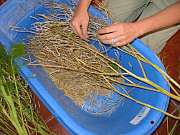
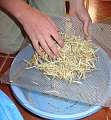
Here's Kate processing some Pak Choi.
You do need to make sure they aren't crossed with anything, as many of the brassicas (cabbages, cauliflowers etc) will cross with each other very readily. See the seedsaving pages at the bottom left hand side of this website for more infomation.
To get the seeds out, flower stalks from a good-sized population are hung up to dry,then broken open over a bowl (or old baby bath in this case!).
The bits of pod are screened out with a sieve or a soil riddle - but you can instead winnow them off in a breeze pretty easily if you prefer.
Step-by-step, highly detailed instructions are here on our new brassica-seedsaving page.
And of course, seed-saving is only possible because these are all real, non-hybrid varieties.
