







Genetically Modified Crops
- Ben says don't believe the spin!
Ben was talking to someone at DEFRA, and they happened to mention in passing: 'you know, we had a big presentation from the industry, and really, GM crops will have to be allowed in if we're to feed everyone, its the only way to solve the food crisis'
Now, this is complete and utter rubbish. It is a line that has been put forward by the GM public relations people in the newspapers as well. The reality is that these faceless corporations have sunk billions and billions of borrowed dollars developing these things, and whether they work or not, they are desperate to get some profit from them any way they can.
So they are lobbying the government to allow them to sell GM seed in the UK, using whatever the latest worry is. (Ten years it was the need for higher vitamins in rice, then making cheap drugs from corn, now a 'food crisis'. )
Once we plant GM crops there's no going back - the genes will escape into wild plants and other food crops. We must all resist this cynical sales push.
Interestingly, Genetically modified crops are the agricultural equivalent of what has been going on with the banks.
The parallels are striking:
- developed to create a profitable 'new market' where none existed before
- massively hyped as a 'new way of doing things'
- hard to understand, even by the regulators
- so regulators accept industry assurances at face value
- and not investigated or tested for safety before use.
- potentially very dangerous to the public
- designed to be costly to large numbers of 'little people' worldwide
- designed to be profitable to just a handful of corporations in USA
- very difficult to contain once the effects get out of control (a "systemic" risk)
And this briefing to the government is simply not true.
Forgetting all the arguments about toxicity and genetic pollution for the moment, concentrate on this simple fact:
GM crops will have LOWER yields than natural plants.
Why 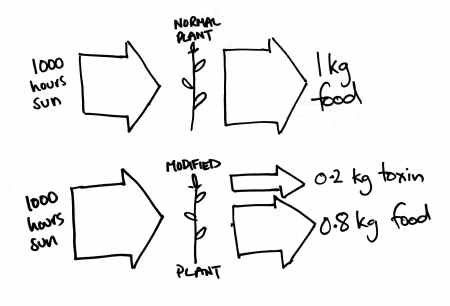 GM Crops will have Lower Yields
It's pretty obvious, looking at this diagram:
Here's a plant , making food from sunlight, as it ought to. It sits there, soaking up sunlight all summer, making grain or corn or whatever.
Now take that plant, and turn it into BT Corn, which 'makes it's own insecticide'. The modification puts in a poison gene from a bacteria. It is locked 'on', so that every bit of the plant has to use some of its energy making a toxic compound.
You can see that you are putting the same energy in, but of course some of that is diverted into making the toxin.
- GM crops won't solve any crisis - they just want our money.
- And they don't care if they poison us & destroy the eco-system (all that toxin might not be so great, you know) in the process.
- GM crops pose a huge risk to the food chain.
- GM foods have not been safety-tested, and should be resisted at all costs.
note : Ben studied genetic engineering at the Department of Plant Sciences in Cambridge.
The security of the worlds food supply is at stake here, at risk to the same sort of short-term, ignorant, greedy fools who wrecked the banking system, which we are still paying off with austerity 18 years later.
Postscript: I first wrote this in 2008. Since then a scientific study by the UCS looking at two dozen different crop trials came to the same conclusion - GM Seeds do not increase yields. |
But what about 'Precision Breeding' ?
This is just GMO under a swanky new name. The UK government fell hook line and sinker for the lobbying by the GM industry - saying that their new techniques were so safe they were the same as normal breeding - and is in the process of deregulating GM foods completely. By the end of 2026 you can be eating GM ingredients with no requirement for labelling!
Whatever nice name it is given, direct intervention at the genetic level is very different from traditional breeding and can result in multiple and unexpected errors across the genome, some of which may pose a threat to people or the environment.
We believe that complete deregulation is a bad idea, and that it is important to have consultations and discussion before these organisms are released into our environment, rather than waiting to see afterwards if there are any problems.
More generally, we don't believe that the problems in our food system will be solved by a techno-fix such as gene-editing.
The UK "Genetic Technology (Precision Breeding) Act" is being implemented now & needs to be stopped - write to your MP
Much more excellent information & explanation is available at GM-Freeze